Subterranean Karst Hydrology
Savica Waterfall (Slap Savica) is unique among major European waterfalls because it does not originate from an open surface river. Instead, it is a karst spring fed by underground drainage networks within the Seven Triglav Lakes Valley (Dolina Triglavskih jezer), situated hundreds of meters above in the high limestone plateau of the Julian Alps.
Precipitation and snowmelt filter down through deep karst shafts and fault lines, gathering into underground reservoirs. Water flows through subterranean chambers until reaching an impervious rock layer, erupting violently through a cave entrance halfway up the sheer 500-meter limestone face of Mount Komarča at an altitude of 836 meters.
The 'A'-Shaped Bifurcation
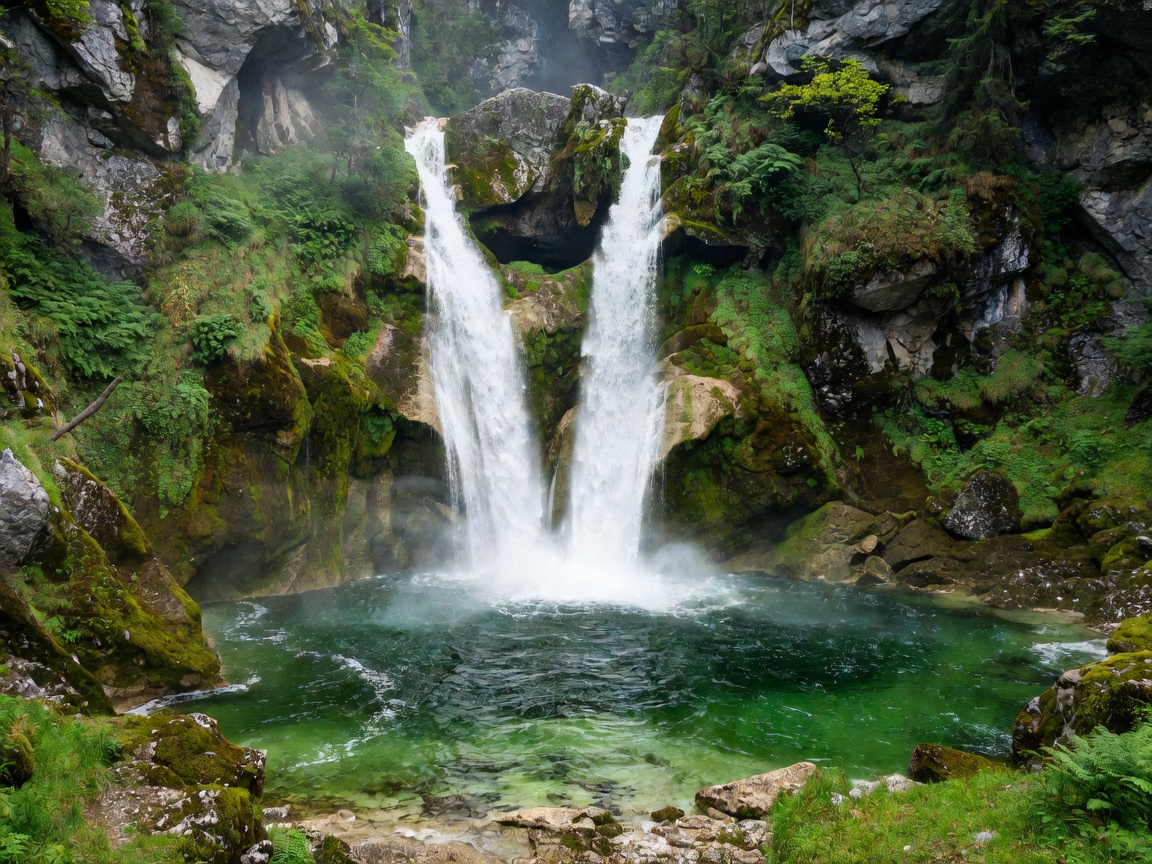
Inside the cave, before daylight is reached, the subterranean stream splits into two distinct branches. The larger left branch plunges 78 meters through an incised vertical slot into an artificial stone plunge pool. The smaller right branch cascades 25 meters down an adjacent fault line.
Together, these two torrents form a distinctive letter 'A' shape before uniting in an emerald-green basin. From this point, the Savica River flows into Lake Bohinj, ultimately feeding the Sava Bohinjka—one of the primary headwater tributaries of the Danube river system.
Expedition Advantages
- Distinctive geological karst emergence unlike standard surface drops.
- Lush beech forest surroundings inside protected Triglav National Park.
- Close proximity to Lake Bohinj and Vogel cable car routes.
Logistical Considerations
- Ascent requires climbing approximately 550 steep stone steps.
- Observation pavilion is locked behind a perimeter fence to prevent cliff accidents.
- Late summer flow can drop noticeably during prolonged dry spells.
Cultural Significance and Trail Approach
Beyond its geological uniqueness, Savica holds deep cultural significance in Slovenian identity. It served as the central geographical setting for the epic poem The Baptism on the Savica (Krst pri Savici) written in 1835 by national poet France Prešeren, celebrating early Slavic history and natural beauty.
Access begins from the trailhead near Koča pri Savici hut. A maintained path of stone steps and timber balustrades winds through ancient beech woods. At the terminal viewing pavilion, hikers are rewarded with views into the turquoise canyon pool framed by towering limestone cliffs.